
INFRASTRUCTURE THAT RUNS EVERYWHERE
YOUR BUSINESS NEEDS TO GO.
Your technology infrastructure is either a competitive asset or an operational constraint. It either scales with your ambitions — new markets, higher transaction volumes, more demanding workloads — or it becomes the ceiling your business grows up against. The difference isn't which cloud provider you're on. It's whether your infrastructure was actually engineered for how your business operates.
Moving to the cloud is not a strategy — it's a decision. What happens after that decision determines whether you get the flexibility, cost efficiency, and resilience the cloud promises, or whether you end up with the same operational problems running on more expensive infrastructure.
Most businesses that struggle with cloud adoption didn't fail at migration. They failed at architecture. They lifted and shifted legacy systems onto cloud infrastructure without redesigning them for how cloud environments actually work — and ended up with unpredictable costs, performance bottlenecks, and security gaps that weren't present on-premise.
At IT WEBHUT, we approach cloud infrastructure as an engineering problem, not a migration project. Whether you're moving existing systems to the cloud, building new cloud-native applications, or optimizing infrastructure that's already there but underperforming, our work starts with understanding your workloads, data governance requirements, compliance obligations, and cost targets.
The result is a cloud environment that's right-sized for your current operations and architected to scale globally — with the security, redundancy, and observability that enterprise operations require.
Key Business Benefits
- Infrastructure That Scales With DemandCloud architecture built correctly scales up during peak load and down when demand drops — so you're not paying for capacity you don't need and not scrambling for capacity when you do.
- Predictable and Optimized Cloud SpendUnoptimized cloud environments consistently cost more than they should. We architect and continuously optimize your infrastructure so your cloud bill reflects actual usage — not idle resources and oversized instances.
- Global Deployment Without Global ComplexityServing customers across multiple regions requires infrastructure that handles latency, data residency, and compliance at the regional level. We architect for global reach from the beginning.
- Enterprise-Grade Security PostureWe implement the security architecture — network segmentation, IAM policies, encryption at rest and in transit, secrets management — so your posture is defensible.
- Business Continuity and Disaster RecoveryWe engineer backup, replication, and recovery systems so that hardware failure, regional outages, or human error don't become business interruptions.
- Faster Development and Deployment CyclesCloud-native infrastructure with proper CI/CD pipelines compresses the time from code to production — so your engineering team ships faster and with less risk on every release.
- Reduced Operational OverheadManaged cloud services handle the maintenance burden of servers, patching, and infrastructure management — freeing your IT team to focus on what differentiates your business.
Why Businesses Choose IT WEBHUT
- We Build on Cloud, Not Just in ItThere's a difference between running software on cloud infrastructure and building software that uses cloud capabilities correctly. We architect applications to take advantage of what cloud environments actually offer.
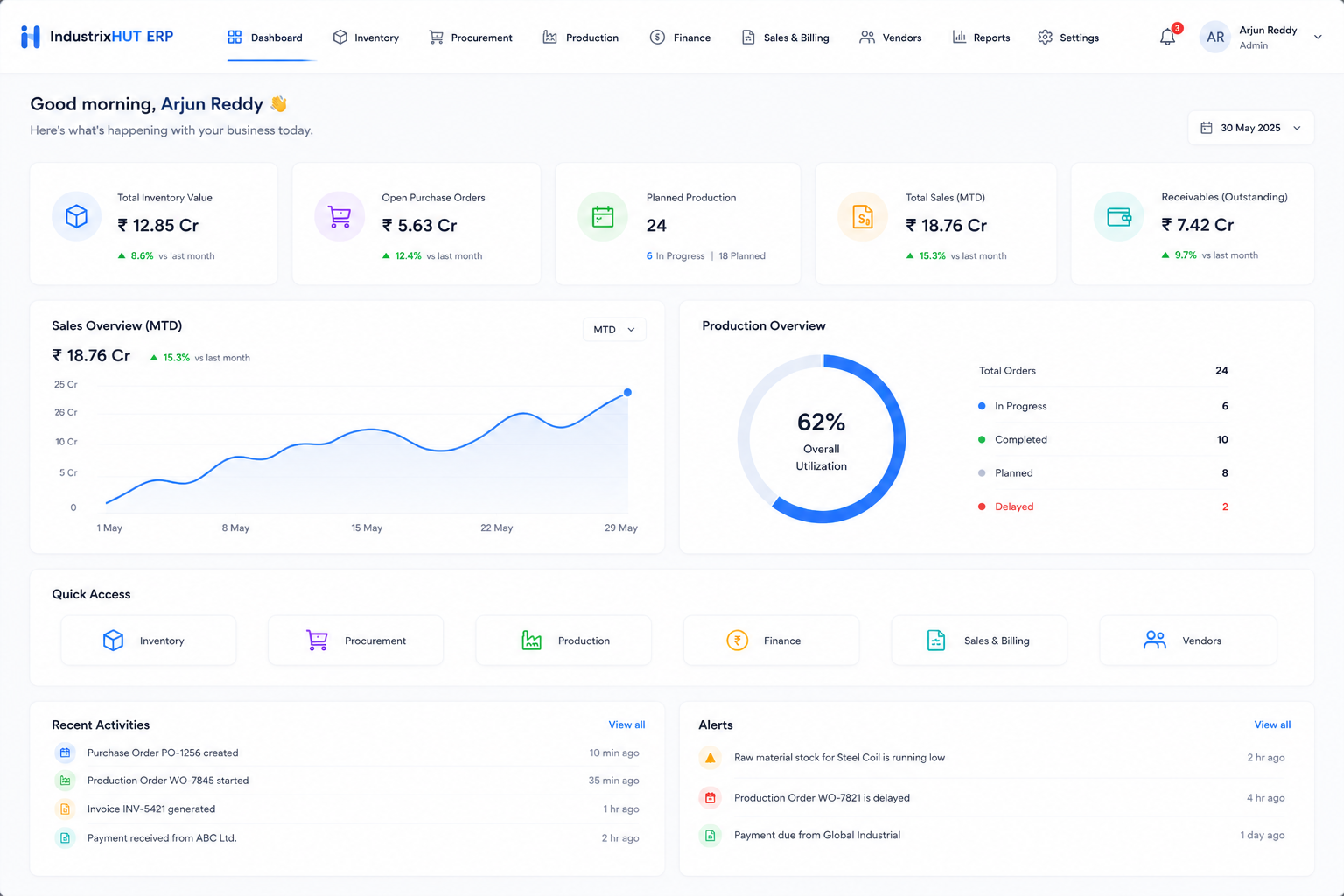
- Our Products Run on the Same InfrastructureHR Workify, Industrix ERP, Docvoult, and every other IT WEBHUT product runs on the cloud infrastructure our team designed and manages.
- Provider-Agnostic, Outcome-FocusedWe don't have a preferred cloud vendor. We have preferred outcomes — performance, cost efficiency, security, and operational resilience.
- Security Is Not an AfterthoughtWe design security into the architecture from the first conversation — not the last sprint before launch.
Industries That Benefit
| Industry | Primary Use Cases |
|---|---|
| Financial Services | High-availability platforms, regulatory data storage, multi-region compliance, disaster recovery |
| Healthcare & Life Sciences | HIPAA-compliant infrastructure, clinical data storage, global research environments |
| Manufacturing & Distribution | IoT data ingestion, real-time production dashboards, multi-site ERP infrastructure |
| Retail & E-Commerce | Auto-scaling for peak traffic, CDN and global delivery, inventory and order system infrastructure |
| Government & Public Sector | Sovereign cloud environments, citizen data protection, compliant public-sector workloads |
| Education & EdTech | Globally accessible learning platforms, video delivery infrastructure, student data compliance |
| SaaS Businesses | Multi-tenant architecture, global deployment, usage-based scaling, cost-efficient infrastructure |
Technologies
Cloud Providers: AWS · Microsoft Azure · Google Cloud Platform · Oracle Cloud
Containers & Orchestration: Docker · Kubernetes · Amazon EKS · Azure AKS · Google GKE · Helm
Infrastructure as Code: Terraform · AWS CloudFormation · Pulumi · Ansible
CI/CD & DevOps: GitHub Actions · GitLab CI · Jenkins · ArgoCD · AWS CodePipeline
Serverless: AWS Lambda · Azure Functions · Google Cloud Functions · AWS Fargate
Monitoring: Datadog · Grafana · Prometheus · AWS CloudWatch · Azure Monitor · ELK Stack
Security: AWS IAM · Azure Active Directory · HashiCorp Vault · AWS Security Hub · CloudTrail
When Do You Need This Service?
- Infrastructure costs are rising faster than usage, with no clear visibility into what's driving them.
- You're planning geographic expansion and need infrastructure that performs consistently across regions.
- Traffic or data volume spikes cause performance degradation instead of graceful scaling.
- You're migrating off legacy on-premise infrastructure and need a plan that doesn't interrupt operations.
- Deployment is manual, slow, or risky enough that releases happen less often than the business needs.
IS YOUR INFRASTRUCTURE KEEPING UP WITH YOUR BUSINESS?
Tell us where your current infrastructure is slowing you down — performance, cost, scale, or security. We'll design the architecture that fixes it.
We assess your current environment before recommending anything. No cloud migration pitch until we know what you're working with.
What We Deliver
- Cloud Architecture Design — End-to-end infrastructure design across compute, storage, networking, and security — built for your specific workloads and compliance requirements.
- Cloud Migration — Structured migration of applications, databases, and infrastructure from on-premise or legacy cloud environments — with zero-downtime cutover planning.
- Cloud-Native Application Development — Applications designed and built to run natively on cloud infrastructure — leveraging managed services, auto-scaling, and serverless architecture.
- Multi-Cloud & Hybrid Cloud Architecture — Infrastructure that spans multiple cloud providers or bridges on-premise and cloud environments without creating operational fragmentation.
- Kubernetes & Container Orchestration — Containerized application deployments managed at scale — with automated scheduling, self-healing, rolling updates, and resource optimization.
- CI/CD Pipeline Engineering — Automated build, test, and deployment pipelines that make releasing software a controlled, repeatable process.
- Cloud Cost Optimization — Rightsizing, reserved instance planning, auto-scaling configuration, and spend governance — reducing cloud costs without compromising performance.
- Security & Compliance Architecture — IAM policy design, network security, encryption, compliance controls for SOC 2, ISO 27001, GDPR, HIPAA, and regional data residency requirements.
- Monitoring, Observability & Alerting — Full-stack observability across infrastructure and application layers — with dashboards, anomaly detection, and escalation paths.
- Disaster Recovery & Business Continuity — Automated backup systems, cross-region replication, RTO and RPO engineering — tested, not assumed.
Our Delivery Process
We audit your current infrastructure, application architecture, data volumes, compliance requirements, and cost baseline. The output is a clear picture of what moves to the cloud, what gets redesigned first, and what the target architecture looks like.
We design your cloud architecture and evaluate provider fit for your specific workloads, regional requirements, and existing vendor relationships. We're provider-agnostic.
We provision your cloud environment, implement networking and security architecture, configure identity and access management, and establish the baseline controls every subsequent workload inherits.
For migration: we execute in defined waves — starting with lower-risk workloads, validating performance and data integrity, then progressing through more complex systems. For new builds: development runs in a cloud-native environment from day one.
We run load tests, failover tests, and security assessments in staging before any production cutover. Go-live is planned — with rollback capability at every stage.
Post-deployment, we monitor performance, optimize costs, apply patches, and manage infrastructure changes as your workloads evolve.
Enterprise FAQs
The right choice depends on your existing stack, compliance requirements, and team familiarity — we assess this rather than defaulting to one provider. All three platforms power our own products in production.
Cost-efficiency is designed into the architecture — right-sizing, auto-scaling, and reserved capacity planning — and monitored on an ongoing basis, not audited once a year after costs have already grown.
Migrations are sequenced to minimize or eliminate downtime, using parallel-run and phased cutover strategies appropriate to your risk tolerance.
Architectures are built to support SOC 2, HIPAA, GDPR, and industry-specific requirements as needed — compliance is a design input, not a retrofit.
Not necessarily. We can hand off with full documentation and training, or continue managing infrastructure under an ongoing engagement — your call.
Backup, failover, and recovery procedures are defined and tested as part of the architecture, with documented recovery time objectives — not assumed.